
If your small entryway looks messy the second you walk in the door, the problem may not be that your home is too small. It may be that the entry has no real drop zone. These small entryway storage ideas are for the indoor front entryway, tiny foyer, or apartment entry where shoes, bags, keys, mail, sunglasses, dog leashes, and daily clutter keep landing in random places.
This is not a mudroom makeover and it is not a back door drop zone. This guide is for the front-door area inside the home—the little space guests see first and your family uses every day. The best small entryway storage ideas make that tiny zone work harder without turning it into a bulky hallway full of furniture.
Real Simple recommends small-entry hacks like wall hooks, narrow benches, back-of-door storage, shoe containment, drop zones, mirrors, and mail trays. Better Homes & Gardens highlights practical entryway organizers such as key holders, baskets, wall coat racks, and narrow shoe cabinets. The Spruce also emphasizes entryway categories like shoes, coats, keys, sunglasses, mail, deliveries, leashes, and umbrellas.
That is why strong small entryway storage ideas start with categories. Shoes need one home. Bags need one hook. Keys need one tray. Mail needs one stop. Dog leashes, sunglasses, and returns need tiny zones so they stop spreading across the floor, console, stairs, or kitchen counter.
If you are working through the full small-space series, pair this with small living room storage ideas, small living room layout ideas, and small living room furniture ideas. If your issue is specifically a back door family zone, use no mudroom back door drop zone ideas instead.
1. First, Notice If the Drop Zone Has No System
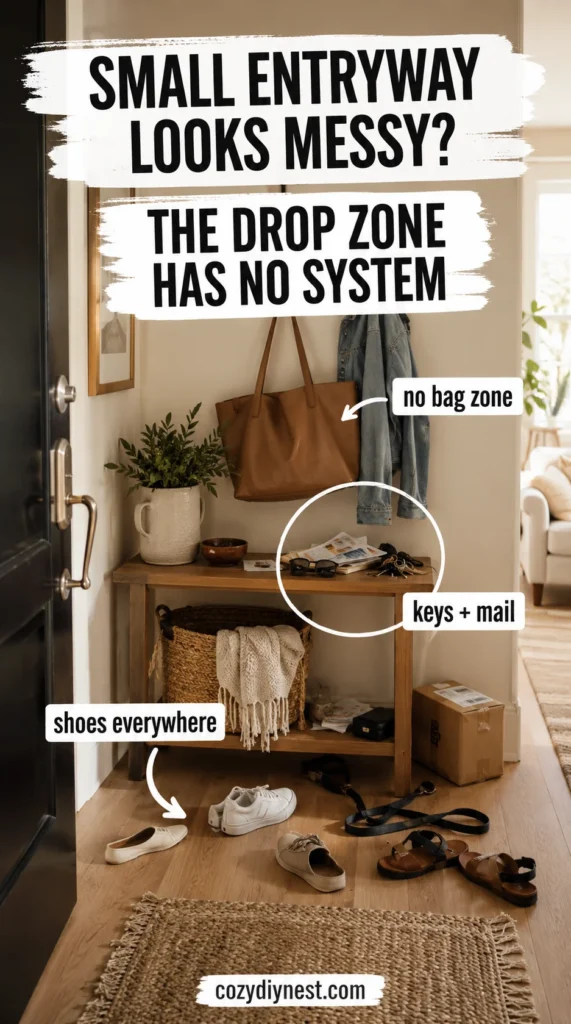
The first step is diagnosis. A small entryway usually looks messy because every item is landing in the same undefined zone. Shoes sit on the floor. Bags hang on a doorknob. Keys get dropped on the nearest surface. Mail starts a little pile. A dog leash ends up wherever someone remembered to put it.
When all of these items share one tiny area without rules, the entry feels crowded fast. The floor looks smaller, the door area feels stressful, and the whole home starts with visual clutter before you even reach the living room.
AI-smart styling test: Take one normal photo of your entryway at the end of the day, before tidying. Circle every item that does not have a real home. If the circles include shoes, bags, keys, mail, sunglasses, and small errands, you need stronger small entryway storage ideas, not more decorative styling.
Real-life solution: Write down the five items that always land near your front door. Those five items decide your entryway system. Practical small entryway storage ideas begin with what your family actually drops, not with a pretty console table that has no job.
2. Choose One Wall to Become the Real Drop Zone
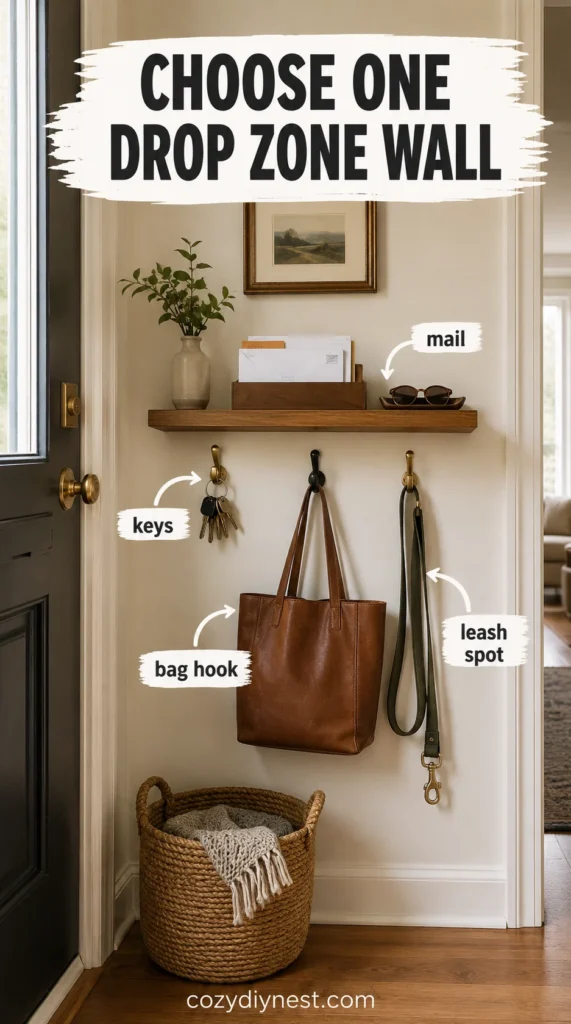
A small entryway does not need storage on every wall. In fact, too many little storage pieces can make the area look busier. The better fix is to choose one wall, corner, or narrow stretch near the door and make it the official drop zone.
This wall can hold a few hooks, a small shelf, a key tray, a mail slot, and one basket below. That is enough to stop the daily items from spreading deeper into the house.
AI-smart styling test: Stand at the front door and notice where your hand naturally wants to drop keys, bag, mail, or sunglasses. The best drop zone is usually within one step of that natural movement.
Real-life solution: Search for entryway wall shelf with hooks, small entryway organizer, key holder with shelf, or wall hooks for entryway. These small entryway storage ideas work especially well in apartments because they use vertical space instead of adding a bulky cabinet.
This is also where you keep the article separate from a mudroom. You are not building a full family command center here. You are creating a small front-door landing system.
3. Contain Shoes Before They Take Over the Door
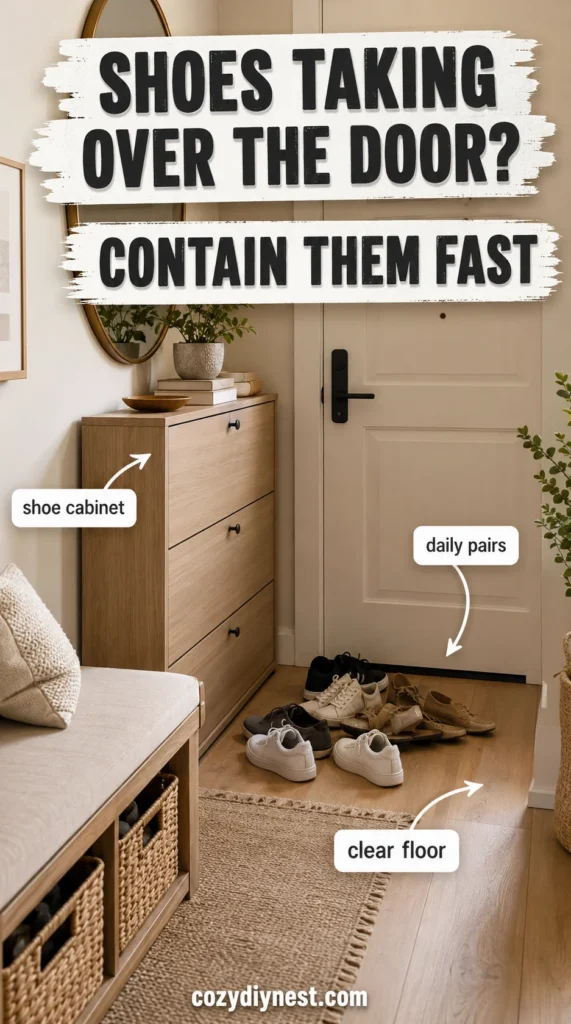
Shoes are usually the first reason a small entryway looks messy. One pair becomes two, two becomes six, and suddenly the door area feels like a shoe traffic jam.
The best shoe solution depends on your space. A slim shoe cabinet hides the visual clutter. A narrow shoe rack keeps daily pairs accessible. A lidded basket or woven basket under a bench can work when you need something softer and more decorative.
AI-smart styling test: Count how many pairs of shoes are sitting by the door on a normal day. If there are more than one or two pairs per person, the entry is storing too much. Move out-of-season, dressy, or backup shoes somewhere else.
Real-life solution: Search for narrow shoe cabinet entryway, small entryway shoe storage, slim shoe rack, shoe storage bench, or woven shoe baskets. The Spruce also highlights small-space shoe solutions like entryway baskets, wood shoe cabinets, over-door storage, and seasonal grouping.
Among all small entryway storage ideas, shoe control is often the fastest visual win because it clears the floor immediately.
If your shoe problem is muddy or wet near a back door, connect this article to mudroom boot tray ideas. For this front-entry article, keep the angle focused on everyday indoor shoes near the main door.
4. Use Wall Hooks So Bags Stop Living on the Floor
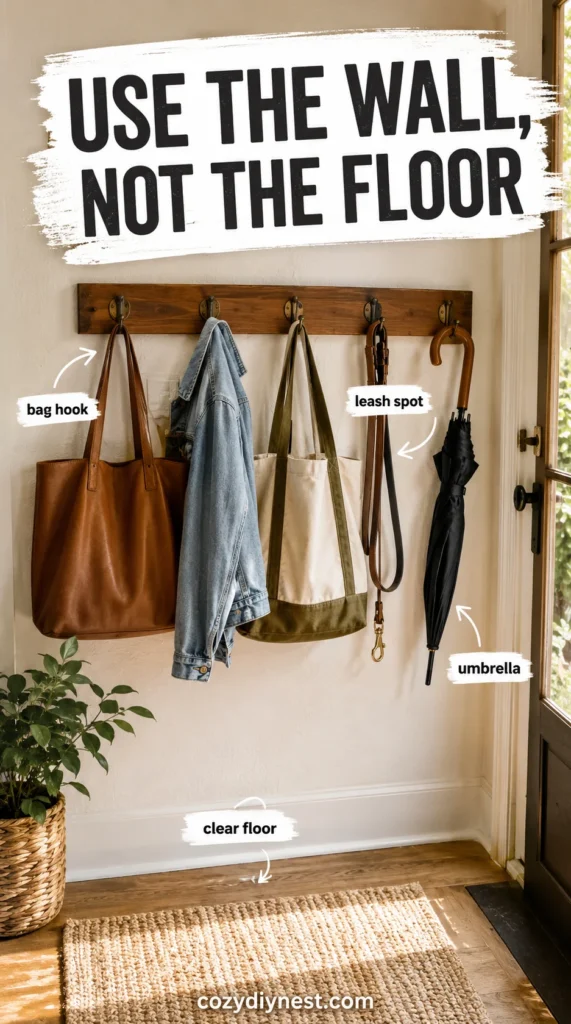
Bags, totes, jackets, umbrellas, and dog leashes can make a small entryway feel messy even when the floor is mostly clear. These items need vertical storage because they are used often and usually dropped quickly.
Wall hooks, peg rails, accordion racks, or a small hook shelf can solve this without taking up floor space. The key is to limit what hangs there. If every hook carries three things, the wall becomes visual clutter too.
AI-smart styling test: Look at what ends up on the floor or chair near the entry. If it has a strap, loop, handle, or leash clip, it probably needs a hook.
Real-life solution: Search for entryway wall hooks, peg rail entryway, small entryway hooks, wall coat rack with shelf, or dog leash hook entryway. These small entryway storage ideas make the drop zone feel intentional without adding bulky furniture.
For a cleaner look, use matching hooks in a warm finish like aged brass, matte black, or natural wood instead of several mismatched hook styles.
5. Give Keys, Mail, and Sunglasses a Tiny Landing Zone
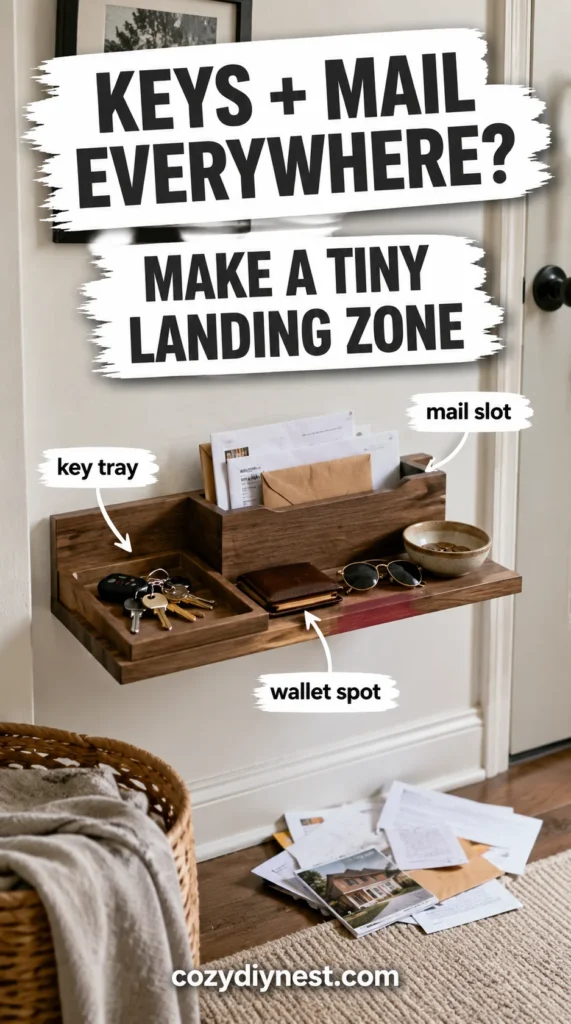
Small entryway clutter often comes from small objects. Keys, wallets, sunglasses, receipts, mail, school papers, and return labels spread fast because they are easy to drop and easy to ignore.
A tiny landing zone can be as simple as a wall-mounted organizer, a narrow shelf, a key tray, and a small mail slot. This keeps the drop zone useful without making the entry look like an office.
AI-smart styling test: Ask where your keys and mail go when your hands are full. If the answer is “wherever,” the entry needs one tray or shelf that handles only small daily items.
Real-life solution: Search for entryway mail organizer, key holder with shelf, key tray entryway, wall mail holder, or small entryway console shelf. The most useful small entryway storage ideas give small items one obvious landing place before they travel to the kitchen counter.
If your entry already has storage but still feels plain, save decor for later with spring entryway decor ideas. Storage should come first because decor cannot fix missing zones.
6. Add a Narrow Bench Only If It Keeps the Walkway Open
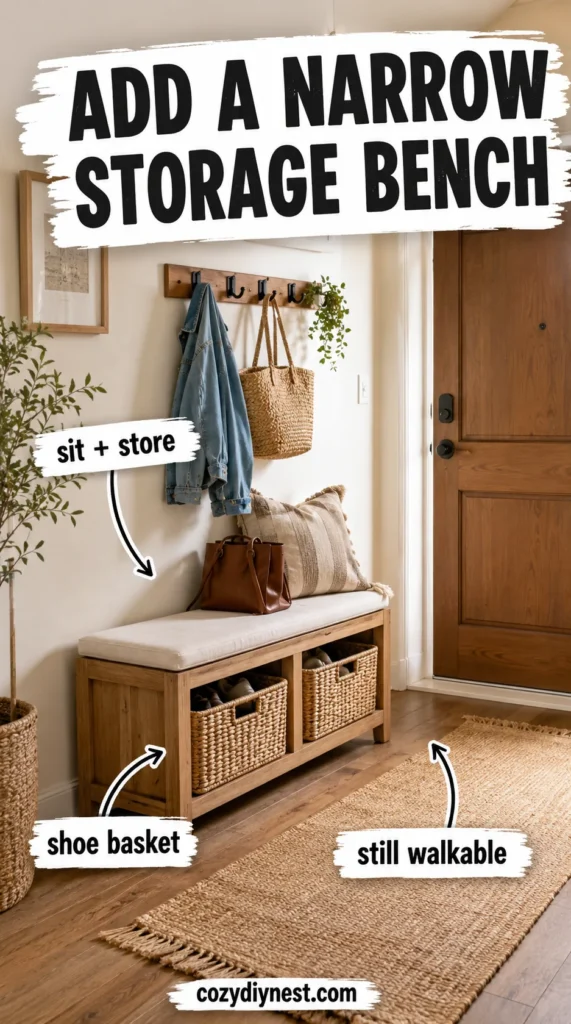
A bench can make a small entryway more useful, but only if it does not block the walkway. In a tiny entry, the wrong bench becomes one more obstacle. The right bench gives you a place to sit, a place to tuck shoes, and a softer way to hide daily clutter.
A narrow bench with storage, baskets underneath, or a slim shoe bench can work beautifully if the entry still has room to open the door and walk through comfortably.
AI-smart styling test: Before buying a bench, mark the footprint with painter’s tape or a folded towel. Walk through the entry normally. If you have to turn sideways, the bench is too deep.
Real-life solution: Search for small entryway bench with storage, narrow entryway bench, entryway shoe bench, storage bench for small entryway, or bench with baskets entryway. These small entryway storage ideas work best when the bench is slim, practical, and visually light.
Choose warm wood, woven baskets, or a soft neutral cushion so the entry feels welcoming without looking heavy.
7. Build a Small Entryway System, Not a Pretty Pile of Organizers
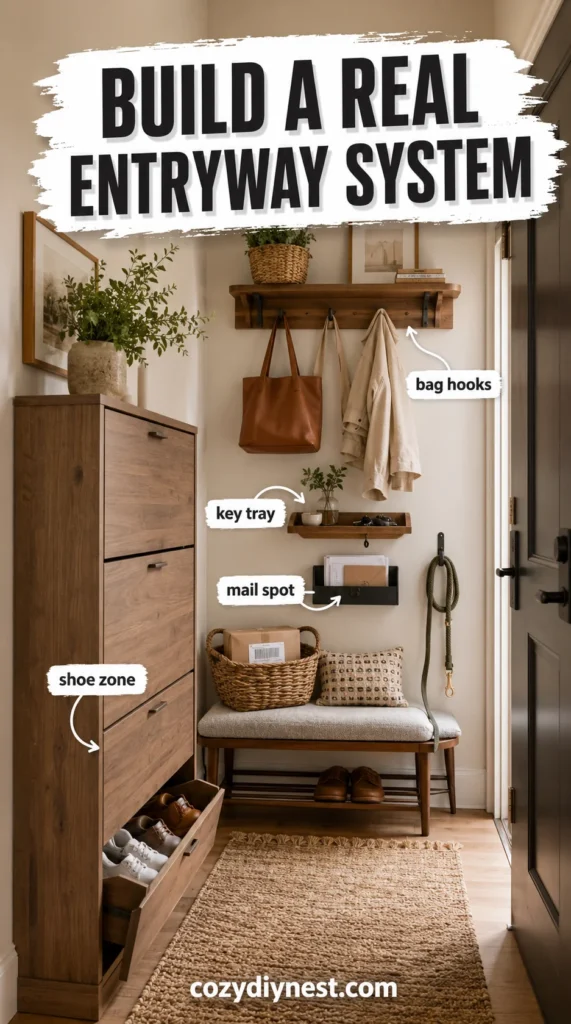
The final fix is to stop buying random entryway organizers and build a system. A strong small entryway system has a shoe zone, bag zone, key zone, mail zone, quick-grab zone, and one small overflow basket.
That does not mean the entry needs to be large. A slim shoe cabinet, three hooks, one wall shelf, one tray, and one basket can be enough. The point is that every daily item has a repeatable place to land.
AI-smart styling test: Name the job of every entryway item out loud. If a piece does not hold shoes, bags, keys, mail, leash, returns, or daily grab-and-go items, it may be decor—not storage.
Real-life solution: Combine two or three small entryway storage ideas instead of relying on one oversized piece. A narrow shoe cabinet plus wall hooks plus a key tray often works better than one bulky hall tree in a tiny front entry.
Once the system is clear, the entry stops feeling like a dumping ground and starts feeling like a calm transition into the home.
Quick Small Entryway Storage Formula
- Choose one drop zone wall: keep the storage system in one clear area near the front door.
- Contain shoes fast: use a narrow shoe cabinet, bench, basket, or slim rack.
- Use wall hooks: lift bags, leash, jacket, and umbrella off the floor.
- Add a key and mail spot: stop small items from spreading into the kitchen.
- Limit daily pairs: do not let every shoe live by the front door.
- Use a narrow bench carefully: only add seating if the walkway stays open.
- Build zones: shoes, bags, keys, mail, leash, and returns each need a home.
If your entry problem is actually a back door family landing zone, read no mudroom back door drop zone ideas. If wet shoes are the issue, use mudroom boot tray ideas. For outdoor curb appeal, keep those topics separate with front door decor ideas and small front porch ideas.
Final Thoughts: Your Small Entryway Needs Zones Before Decor
The best small entryway storage ideas do not make the entry feel packed. They make the daily clutter easier to land, easier to find, and easier to reset.
Start with the biggest pain by the door. If shoes are everywhere, solve shoes first. If keys and mail scatter across surfaces, create a tiny landing zone. If bags live on the floor, install hooks before buying another basket.
Your small entryway does not need to become a mudroom. With the right small entryway storage ideas, it can become a compact, calm, front-door drop zone that works every day.
FAQ: Small Entryway Storage Ideas
What are the best small entryway storage ideas?
The best small entryway storage ideas include a narrow shoe cabinet, wall hooks, key tray, mail organizer, slim bench, woven baskets, leash hook, and one small drop zone shelf near the front door.
How do I organize a small entryway with no closet?
Use vertical storage first. Add wall hooks for bags and jackets, a narrow shoe cabinet or basket for daily shoes, and a small shelf or tray for keys and mail. Keep only daily-use items near the door.
How do I stop shoes from taking over a small entryway?
Limit the number of daily shoes by the door and use a narrow shoe cabinet, slim rack, lidded basket, or storage bench. Move out-of-season and rarely worn shoes to a closet or bedroom storage area.
What should go in an entryway drop zone?
An entryway drop zone should hold only daily items such as shoes, keys, mail, sunglasses, bags, leash, wallet, and one or two quick-grab items. It should not become a storage area for everything in the house.
How can renters create entryway storage?
Renters can use removable hooks, freestanding shoe cabinets, slim benches, baskets, over-door organizers, and wall shelves where allowed. These small entryway storage ideas create function without a renovation.
Is a small entryway the same as a mudroom?
No. A small entryway is usually the front-door indoor area or apartment entry. A mudroom is usually a heavier-duty family landing zone near a back door, garage, or laundry area. The storage needs can overlap, but the search intent is different.