
If your small kitchen has no pantry, grocery day can feel like a storage emergency. These small kitchen no pantry ideas are for the apartment kitchen, rental kitchen, or compact home where cereal boxes, snacks, cans, pasta, coffee supplies, and paper towels keep taking over the counter, cabinet tops, fridge side, or dining area.
The problem is not always that you bought too much food. The real problem is that the food has no assigned home. Without a pantry, every grocery category starts looking for space: snacks land on the counter, cans disappear in deep cabinets, cereal boxes crowd shelves, and overflow items end up wherever there is a gap.
Homes & Gardens recommends solutions for kitchens without a pantry such as roll-out shelves, smart shelf zoning, cabinet-door storage, freestanding pantry units, and narrow fridge-side storage. Apartment Therapy also suggests open shelving, bookshelves, and clear labeled containers for kitchens without a pantry. And The Kitchn highlights smart small kitchen storage ideas that make better use of cabinets, walls, shelves, and every available inch.
That is why the best small kitchen no pantry ideas do not simply hide groceries anywhere they fit. They create a food storage system: one mini pantry zone, one overflow solution, one snack boundary, one vertical storage move, and one clear rule for what deserves prime cabinet space.
If your counters are also crowded with daily-use items, start with our small kitchen organization ideas. If you are following the full small-space series, pair this with small living room layout ideas, small living room storage ideas, and small living room furniture ideas.
1. First, Notice Where the Groceries Are Taking Over
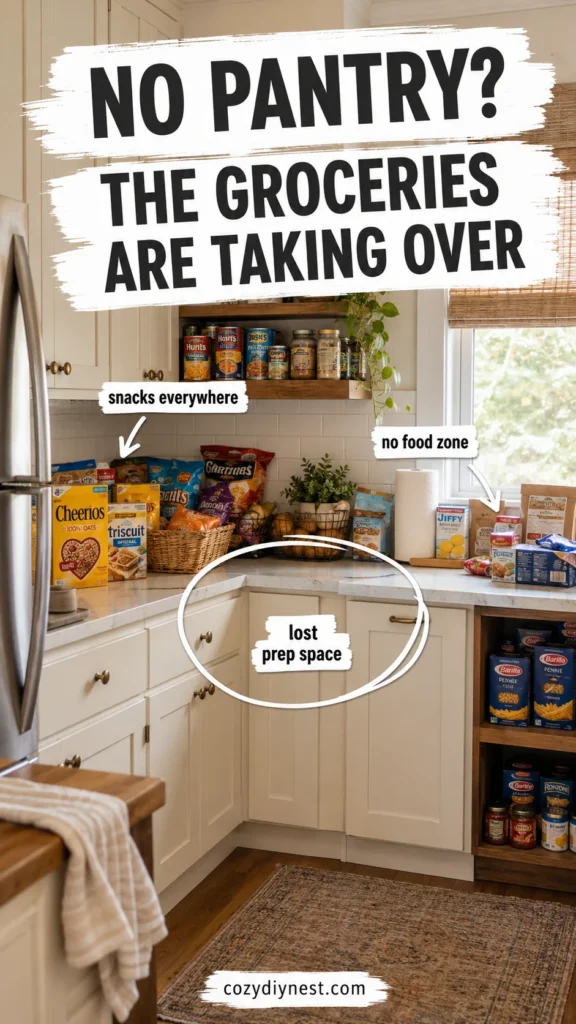
The first step is diagnosis. A small kitchen without a pantry usually does not fail in one dramatic way. It fails in little piles. Cereal boxes sit on top of the fridge. Snacks live in an open basket. Cans hide behind dishes. Pasta boxes slide into random cabinets. Paper towels take up counter space.
When groceries are scattered across five different zones, the kitchen feels more crowded than it really is. You lose prep space, forget what you already bought, and keep rebuying items because nothing is visible in one clear system.
AI-smart styling test: Take one normal photo after grocery day. Circle every food item that does not have a real home. If the circles land on the counter, fridge top, floor, open shelves, and random cabinets, you need stronger small kitchen no pantry ideas, not just more containers.
Real-life solution: Write down your biggest food overflow category first: snacks, cereal, cans, baking items, coffee supplies, paper goods, or bulk groceries. The category that spreads the most should get the first storage fix.
2. Turn One Cabinet Into a Mini Pantry Zone
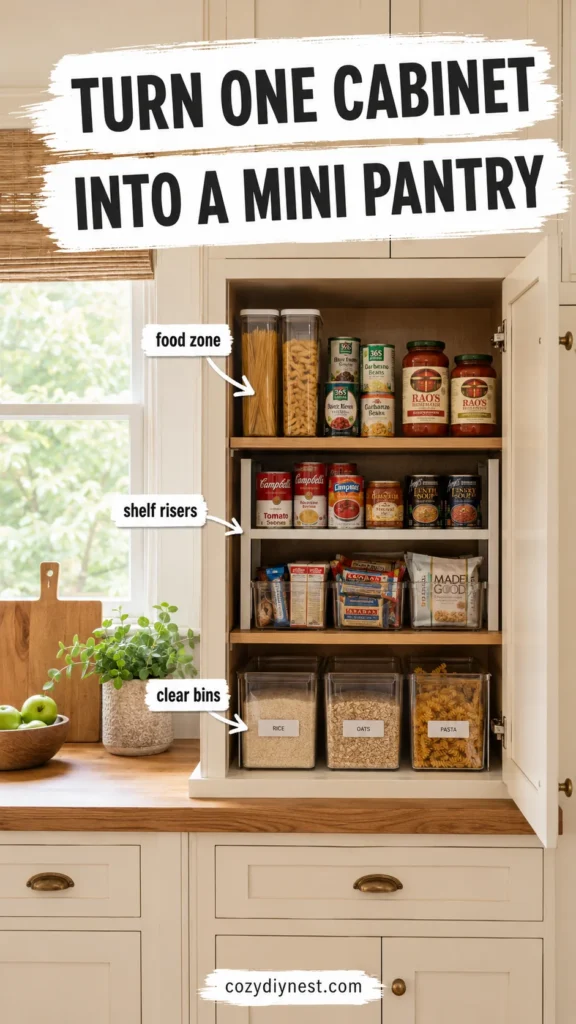
The strongest fix is usually not adding more storage first. It is choosing one cabinet and making it the official mini pantry. This gives your groceries a home base instead of letting food spread through every cabinet in the kitchen.
A good mini pantry cabinet can hold daily snacks, cans, pasta, rice, breakfast items, coffee refills, or baking supplies. Shelf risers, clear bins, turntables, and pull-out shelves help the cabinet work harder without needing a renovation.
AI-smart styling test: Open the cabinet where most pantry food already lives. If items are stacked behind each other and you cannot see what you own, the cabinet needs zones, not just more stacking.
Real-life solution: Search for shelf risers for kitchen cabinets, pull out cabinet shelves, clear pantry bins, turntable for cabinet, or stackable food storage bins. Among all small kitchen no pantry ideas, a mini pantry cabinet is the most natural first step because it uses storage you already have.
3. Add a Slim Pantry Substitute if Cabinets Are Already Full
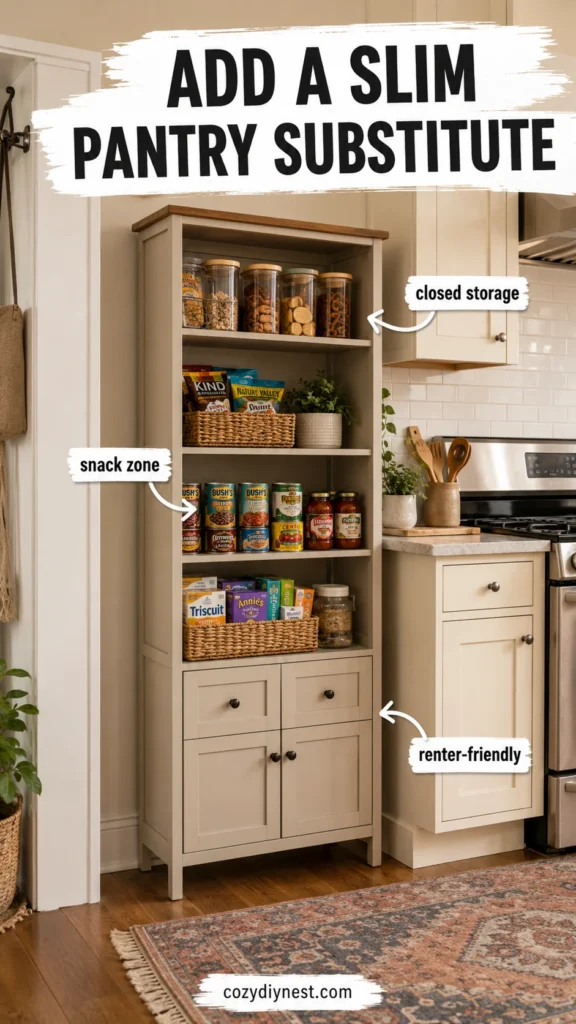
If your cabinets are too small, too shallow, or already full of dishes, you may need a pantry substitute. This does not have to be a custom built-in. A slim pantry cabinet, narrow sideboard, small hutch, or freestanding storage unit can become the food zone your kitchen never had.
Closed storage is especially helpful because it hides the grocery chaos. Open shelves can look beautiful, but if they are packed with snack bags, cereal boxes, and bulk items, they may make the kitchen feel more cluttered.
AI-smart styling test: Look for one unused wall, dining nook, hallway edge, or fridge-adjacent corner. If a slim cabinet could fit there without blocking the walkway, that may be your missing pantry substitute.
Real-life solution: Search for freestanding pantry cabinet, slim pantry cabinet, narrow kitchen cabinet, small hutch for kitchen storage, or sideboard pantry storage. These small kitchen no pantry ideas work well for renters because the storage can move with you later.
4. Use the Back of a Door Like Hidden Pantry Space
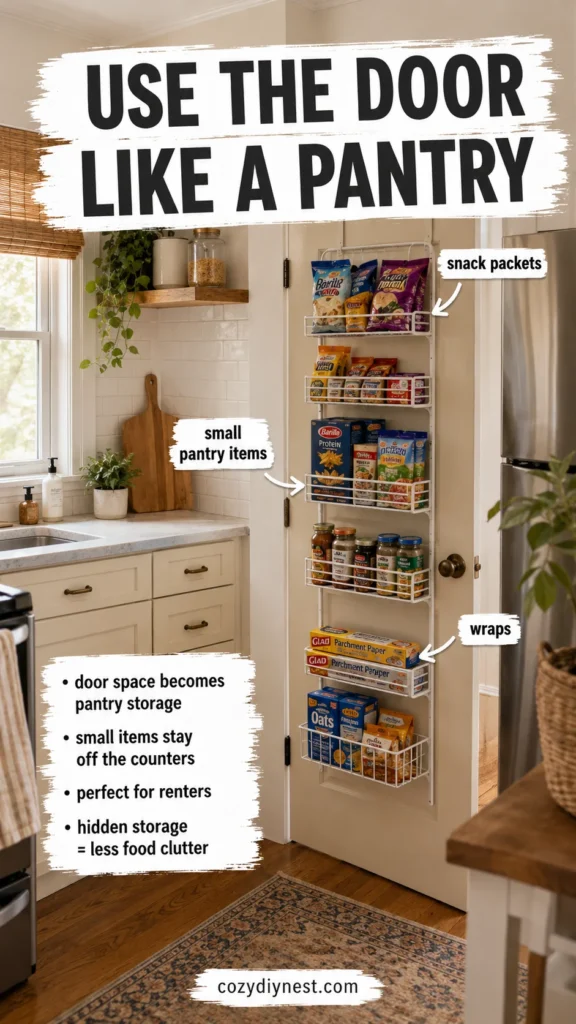
The back of a kitchen door, cabinet door, or nearby closet door can become valuable food storage. This is especially useful for light items like snacks, wraps, packets, spice pouches, baking extras, and lunchbox supplies.
Door storage works because it uses vertical space that is usually ignored. It also keeps small items from spreading across shelves, counters, and drawers. For renters, over-the-door organizers can be especially useful because many do not require permanent installation.
AI-smart styling test: Gather all small food items that disappear easily: packets, bars, wraps, snack bags, seasoning envelopes, and lunch supplies. If they are currently scattered, they are good candidates for door storage.
Real-life solution: Search for over the door pantry organizer, cabinet door spice rack, over cabinet door organizer, or door storage for snacks. Smart vertical door storage is one of the most renter-friendly small kitchen no pantry ideas because it creates storage without taking floor space.
5. Use a Rolling Cart or Narrow Gap Cart for Overflow Groceries
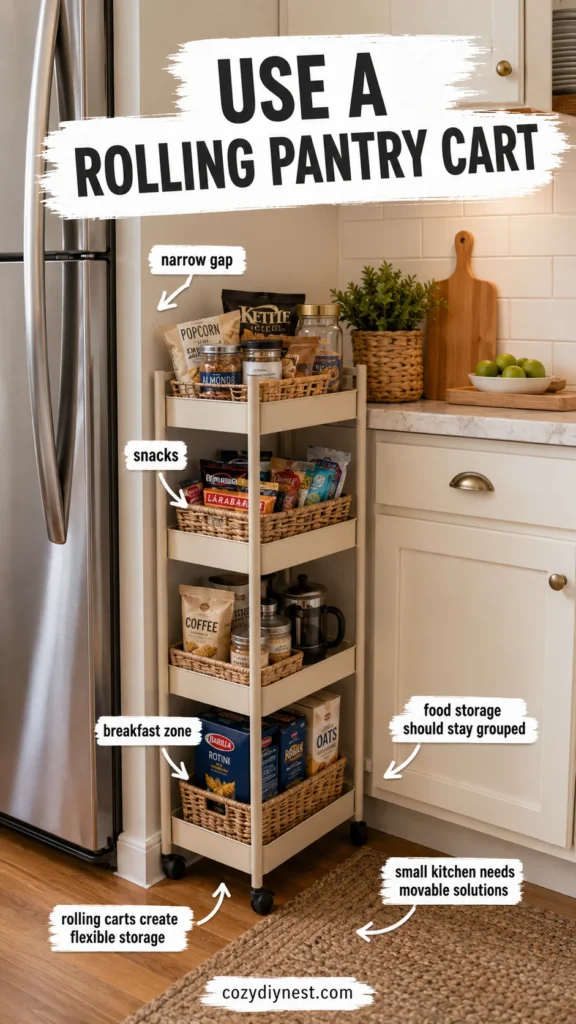
A rolling cart can become a flexible pantry when your kitchen has no built-in food storage. It works especially well for coffee supplies, breakfast items, snacks, oils, baking extras, or weekly overflow groceries.
The key is to give the cart one purpose. If it becomes a random catch-all, it will create the same clutter problem in a new place. But if it becomes a breakfast cart, snack cart, coffee cart, or baking cart, it can make the kitchen feel much more organized.
AI-smart styling test: Find the grocery category that always spills over after shopping. If it is breakfast food, snacks, or coffee supplies, that category may deserve a rolling cart instead of stealing cabinet space.
Real-life solution: Search for rolling kitchen cart, narrow gap storage cart, 3 tier kitchen cart, slim pantry cart, or small kitchen cart with shelves. These small kitchen no pantry ideas are practical because the cart can move when you clean, cook, or rearrange.
6. Use Clear Bins Only for the Categories That Create Chaos
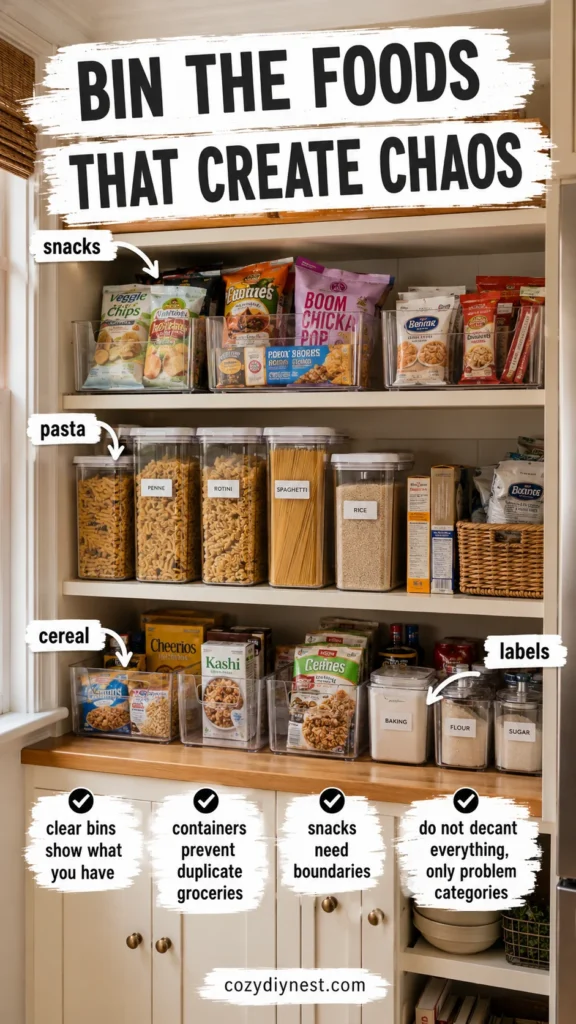
You do not need to decant every single grocery item into matching containers. That can become expensive, time-consuming, and unrealistic. Instead, use clear bins and containers for the categories that actually create mess.
Snacks, cereal, pasta, rice, baking items, coffee pods, and kids’ lunch supplies usually benefit from boundaries. Clear bins help you see what you have, prevent duplicate buying, and keep similar items together.
AI-smart styling test: Look at your groceries and ask which category spreads the fastest. If snacks explode across the cabinet, bin snacks first. If pasta boxes keep falling over, solve pasta first. Do not organize categories that are already behaving.
Real-life solution: Search for clear pantry bins, stackable food containers, cereal containers, snack organizer bins, can organizer, or pantry labels. The most realistic small kitchen no pantry ideas solve the loudest category first, not the whole kitchen at once.
7. Build a No-Pantry System, Not a Random Storage Collection
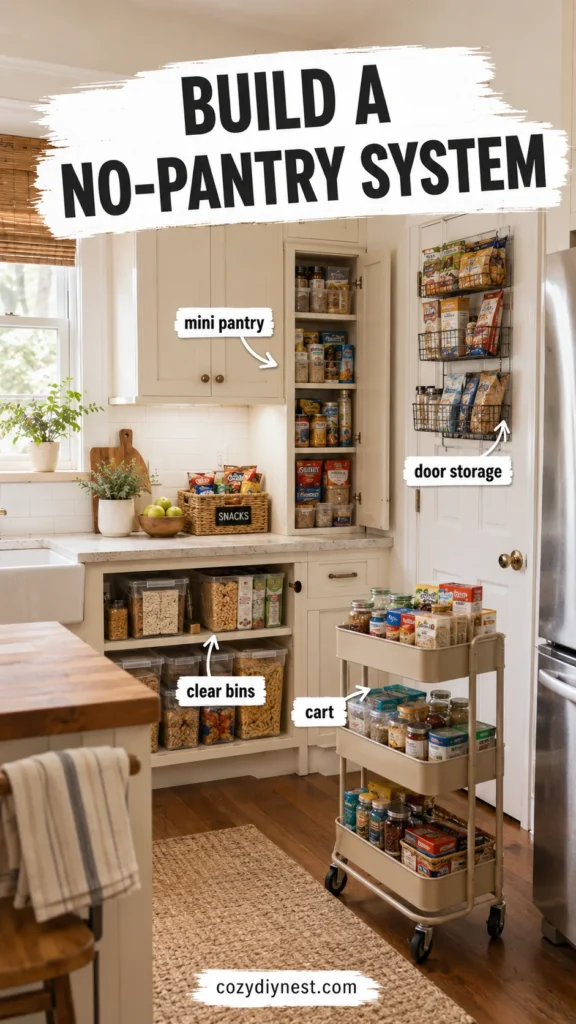
The final fix is to stop thinking of each organizer separately. A no-pantry kitchen needs a system. One cabinet becomes the mini pantry. One cart handles overflow. One door holds small items. One bin system controls snacks. One shelf holds backup paper goods or bulk items.
When every grocery category has a home, the kitchen stops feeling like food is leaking into every corner. The counter becomes usable again. Cabinets become easier to open. Grocery day feels less chaotic.
AI-smart styling test: Name each storage zone out loud: snack zone, breakfast zone, canned goods zone, coffee backup zone, paper goods zone, baking zone. If a category has no zone, that is the one that will keep taking over.
Real-life solution: Combine two or three small kitchen no pantry ideas instead of relying on one miracle product. A cabinet plus clear bins plus a rolling cart can work better than one oversized shelf that becomes messy within a week.
Once the food has zones, your small kitchen can feel calmer even without a real pantry.
Quick No-Pantry Kitchen Formula
- Find the grocery overflow: identify whether snacks, cereal, cans, pasta, or bulk items are taking over.
- Choose one mini pantry cabinet: keep daily pantry staples in one clear zone.
- Add a pantry substitute: use a slim cabinet, hutch, sideboard, or freestanding unit if cabinets are full.
- Use door storage: move small packets, wraps, and snacks onto a door organizer.
- Try a rolling cart: use it for breakfast, snacks, coffee, or grocery overflow.
- Use bins selectively: organize only the categories that create mess.
- Create zones: every food category needs a home so groceries stop spreading.
If your no-pantry kitchen also has crowded counters, continue with small kitchen organization ideas. For the rest of your small home, read small living room layout ideas, small living room storage ideas, and small living room furniture ideas.
Final Thoughts: No Pantry Does Not Mean No Food Storage System
The best small kitchen no pantry ideas do not try to copy a walk-in pantry. They create a realistic food storage system for the space you actually have.
Start with the groceries that take over first. Then give that category a real home: one cabinet, one cart, one door organizer, one narrow shelf, or one set of clear bins. Once the loudest category is controlled, the whole kitchen feels calmer.
Your small kitchen does not need a huge pantry to feel organized. It needs clear zones, smarter vertical storage, and a plan that stops groceries from spreading across every surface.
FAQ: Small Kitchen No Pantry Ideas
What are the best small kitchen no pantry ideas?
The best small kitchen no pantry ideas include turning one cabinet into a mini pantry, using a slim pantry cabinet, adding over-the-door storage, using a rolling cart, organizing with clear bins, and creating food zones for snacks, breakfast, cans, and coffee supplies.
How do I organize a small kitchen without a pantry?
Start by choosing one food storage zone. Then use shelf risers, clear bins, pull-out shelves, door organizers, and a rolling cart if needed. The goal is to keep groceries grouped by category instead of scattered across the kitchen.
Where should food go if my kitchen has no pantry?
Food can go in one organized cabinet, a freestanding pantry cabinet, a slim rolling cart, a sideboard, a bookshelf, or door storage. Choose one main zone and one overflow zone so food does not spread everywhere.
What can I use instead of a pantry?
You can use a slim pantry cabinet, rolling cart, narrow bookshelf, sideboard, hutch, cabinet with pull-out shelves, or over-the-door organizer. These pantry alternatives work well for rentals and small apartments.
How do renters create pantry storage?
Renters can create pantry storage with movable pieces like rolling carts, freestanding cabinets, clear bins, door organizers, magnetic fridge racks, and shelf risers. These options do not require permanent remodeling.
How do I stop groceries from taking over my small kitchen?
Give each grocery category a home. Snacks, cereal, cans, pasta, coffee supplies, and paper goods should each have a clear zone. When categories have homes, groceries stop spreading across counters, shelves, and floors.