
If your living room feels cold even after you have a sofa, rug, curtains, and lamps in place, the problem may not be the main furniture. It may be the corners. These living room corner ideas are designed for the kind of room that looks furnished at first glance, but still feels unfinished because one or two corners are blank, awkward, or visually dead.
An empty corner can quietly cool down an entire living room. Your eye sees the sofa, the coffee table, the rug, and then suddenly lands on a blank wall or unused floor gap. That gap makes the room feel less cozy because it breaks the visual rhythm. The space looks almost complete, but not fully pulled together.
American design sources keep pointing to the same principle: awkward or empty spaces need intention, not random filler. The Spruce recommends treating empty living room corners with ideas like large plants, reading corners, sculptural floor lamps, and textural displays. Better Homes & Gardens shows how a reading chair and artwork can define an awkward area, while Martha Stewart highlights the appeal of cozy rest corners built for calm, comfort, and retreat.
That is why this guide is not about filling every corner with decor. It is about diagnosing what the corner is missing: height, function, softness, texture, storage, or color connection. The best living room corner ideas make the corner feel like it belongs to the room instead of looking like a leftover empty spot.
If your living room also feels cold because of lighting, rug color, or sofa styling, pair this guide with our how to make a living room feel cozy guide, our layered lighting living room fixes, our best rug color for living room guide, and our throw pillow ideas for living room article.
1. First, Find the Empty Corner Making Your Living Room Feel Cold
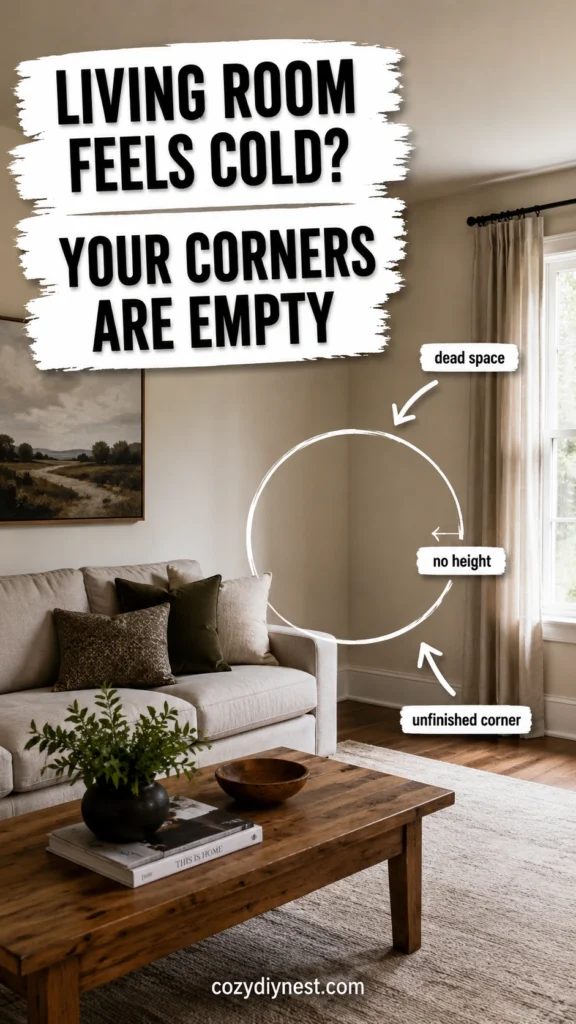
The first step is not shopping. It is diagnosis. Many living rooms feel cold because one corner has no job, no height, and no visual weight. A blank corner beside a sofa, near a window, behind a chair, or next to a fireplace can make the entire room feel unfinished even when the main furniture pieces are attractive.
Take one straight-on phone photo from the doorway or the widest view of the room. Then ignore the sofa for a moment. Look only at the corners. If your eye lands on a blank wall, empty floor, exposed outlet, lonely chair, or random object with no purpose, that corner is probably cooling down the room visually.
AI-smart styling test: Use the photo like a simple visual heat map. Mark the warm zones first: sofa, rug, lamp, pillows, curtains, artwork. Then mark the cold zones: blank corner, empty wall height, lonely floor gap, or dead space with no texture. If the cold zones pull your eye harder than the warm zones, your living room will feel cold in photos and in real life.
Real U.S. market fix: Do not buy a random accent chair or faux plant yet. First decide what the corner is missing. If the corner has no height, think tree, lamp, or shelf. If it has no function, think reading spot or side table. If it feels hard, think woven basket, throw, plant, or warm wood. Strong living room corner ideas start with the missing layer, not with a random product.
2. Add a Tall Faux Tree When the Corner Needs Height and Softness
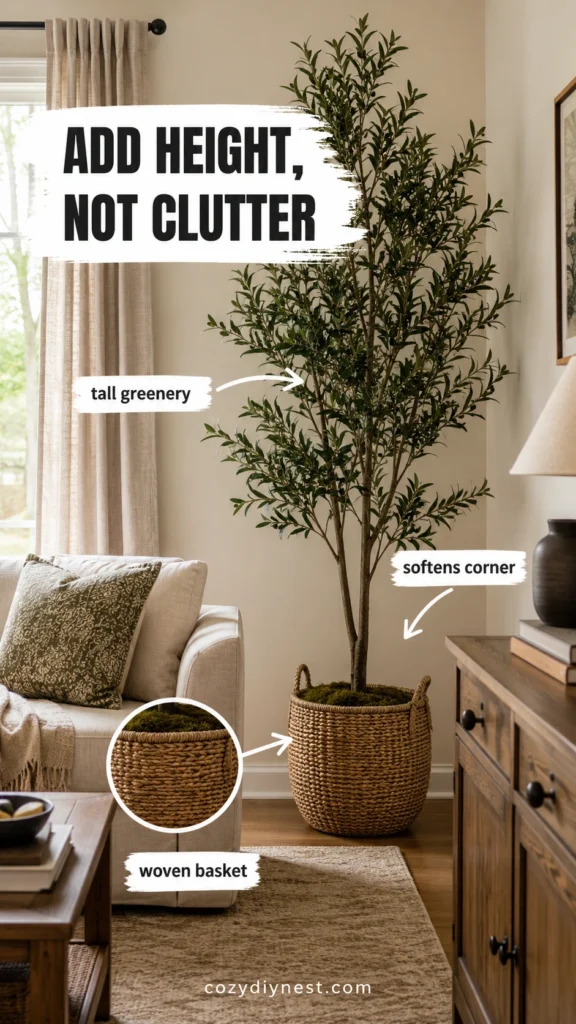
If the corner feels flat from floor to ceiling, your living room probably needs height. A tall faux olive tree, ficus tree, rubber tree, or large indoor plant can soften the hard lines of the wall and make the room feel more alive. This works especially well in beige, cream, gray, and neutral living rooms where the palette is calm but slightly too quiet.
Greenery works because it adds organic shape. A straight wall, straight curtain panel, straight sofa back, and straight coffee table can make a living room feel rigid. A tall tree breaks that stiffness with irregular leaves, natural movement, and richer green contrast.
AI-smart styling test: Look at your corner photo and notice where most furniture stops. If everything stops around sofa-back height, the top half of the wall may feel empty. A tall tree fills the vertical gap and pulls the eye upward without adding bulky furniture.
Real U.S. market fix: Search for faux olive tree living room, artificial ficus tree, large faux tree with planter, or woven basket for faux tree. Target carries faux olive trees with woven basket options, Home Depot lists tall artificial olive trees for indoor home decor, and Wayfair has faux trees designed for empty living room corners.
For the warmest result, place the tree in a woven basket, warm ceramic planter, or textured planter cover. Avoid a tiny plastic pot that looks too small for the tree. The basket is part of the warmth because it adds texture at floor level, exactly where an empty corner often feels cold.
3. Turn the Empty Corner Into a Cozy Reading Spot
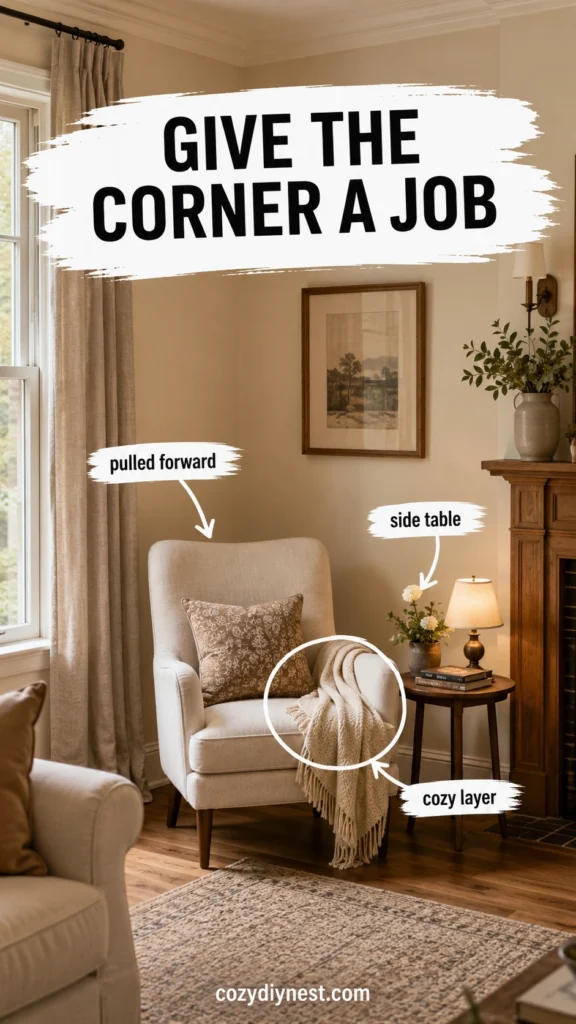
Some corners feel cold because they do not have a purpose. A chair shoved into the corner can look lonely, but a chair that is part of a small reading spot can make the same area feel warm and intentional. The difference is function.
A cozy corner needs more than a chair. Add a small side table, a pillow, a throw blanket, and a simple piece of wall art or a nearby lamp. This tells the eye that the corner is meant for reading, resting, or slow evenings, not just filling space.
AI-smart styling test: Ask one brutally practical question: “Would anyone actually sit here?” If the answer is no, the chair is not creating a cozy corner. Pull the chair slightly forward, give it a reachable surface, and add one soft textile layer. The corner should invite use, not just occupy square footage.
Real U.S. market fix: Search for small accent chair for living room, round side table, reading nook chair, small living room side table, and cozy throw blanket. For small rooms, choose a slipper chair, barrel chair, or armless accent chair. For warmer style, look for soft upholstery, warm wood legs, curved arms, or a textured boucle-like finish.
If the corner is near a window, soften the area with curtains that support the nook. Our layered window treatments guide can help if the window still feels bare, and our curtain rod width guide can help if the window area feels too boxed in.
4. Use a Slim Shelf or Bookcase When the Corner Needs Personality
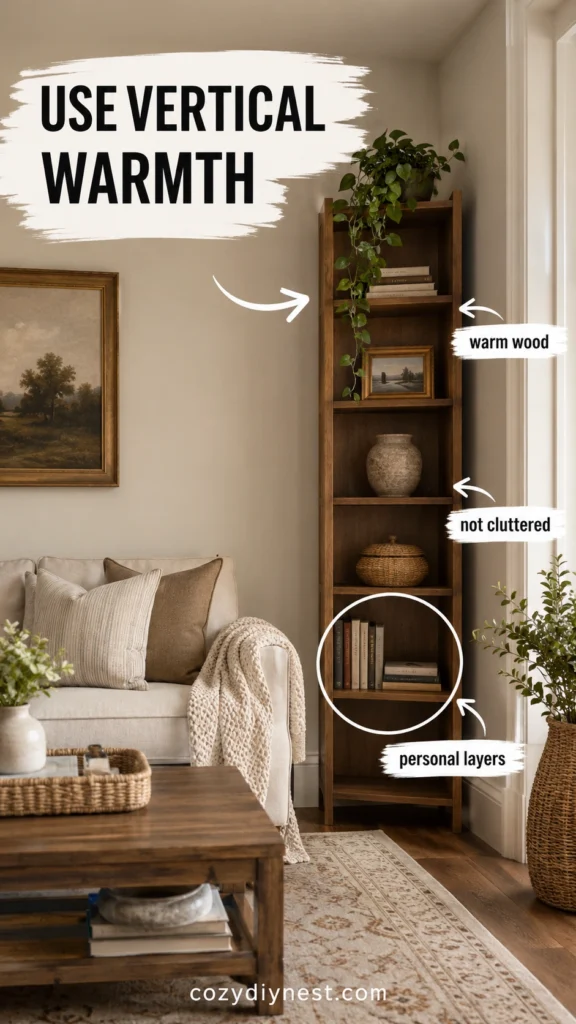
A living room can feel cold when the corners have no personality. If the room is neutral, clean, and simple, a slim shelf or narrow bookcase can add warmth without overwhelming the layout. The goal is not to create storage for everything. The goal is to create a small vertical story.
Choose warm wood when possible. A stark white shelf can disappear into a pale wall or make the corner feel more sterile. A warm oak, walnut, cane, or wood-tone shelf adds natural warmth and helps the corner feel collected.
AI-smart styling test: Look at the shelf from across the room, not up close. If every shelf is full, it will feel cluttered. If every shelf is empty, it will feel cold. Use a simple rhythm: books, object, plant, basket, frame, open space. The open space is what makes the styling feel intentional instead of crowded.
Real U.S. market fix: Search for slim bookcase living room, corner shelf living room, ladder shelf, warm wood bookcase, and small woven storage basket. Add books, one trailing plant, a framed photo, a textured vase, and a basket. These are easy U.S.-market pieces that make a corner feel lived-in without turning it into clutter.
Keep the shelf connected to the room. Repeat one color from your rug, pillows, or artwork. If your rug has warm rust, brown, or olive tones, use our rug color cheat sheet to choose shelf objects that feel connected instead of random.
5. Anchor the Empty Corner With a Sculptural Floor Lamp
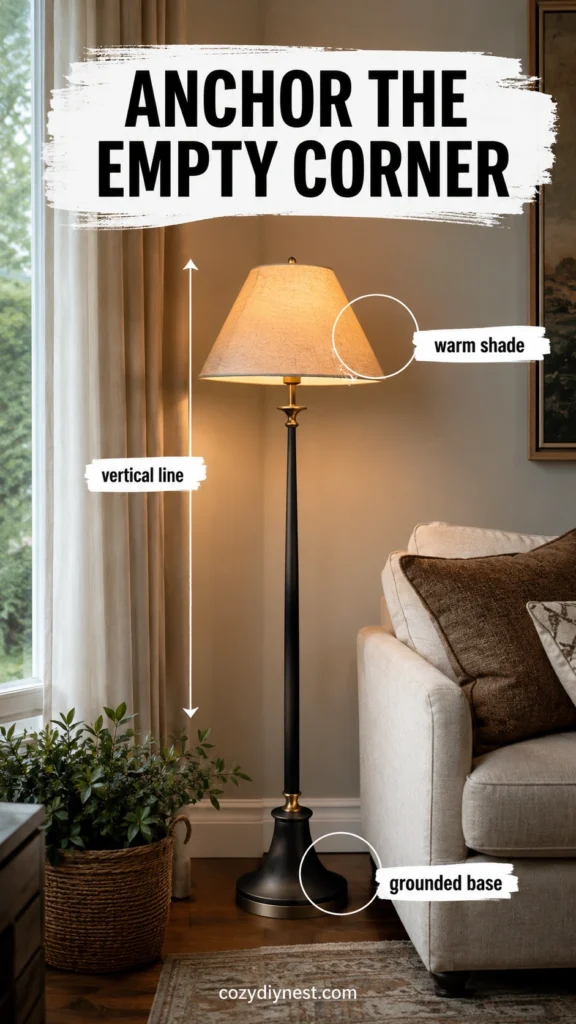
This article is not repeating the full lighting article, but an empty corner often needs a vertical anchor. A sculptural floor lamp can give the corner height, shape, and a reason to exist. It works especially well when the corner is too narrow for a chair or too dark for a plant to feel visually alive.
The mistake is choosing a lamp that is too tiny or placing it in the corner alone. A floor lamp looks more intentional when it has a grounding layer nearby: a woven basket, small stool, planter, side table, or chair. Without that lower layer, the lamp can look like it was dropped into the corner at the last minute.
AI-smart styling test: If your corner has a tall lamp but still feels empty, the problem is probably the base. The eye needs height and grounding together. Add one low texture at floor level, such as a basket, plant, or small stool, so the lamp feels anchored instead of lonely.
Real U.S. market fix: Search for floor lamp with fabric shade, arched floor lamp living room, brass floor lamp, wood floor lamp, or sculptural floor lamp. Look for warm finishes like aged brass, warm wood, linen shade, rattan shade, mushroom shade, or matte black with a warm bulb.
If your living room feels cold mostly at night, connect this corner fix with our layered lighting living room article. The floor lamp can support the room’s glow, but it should not be the only warm light in the space.
6. Use a Basket and Throw When You Do Not Have Room for Furniture
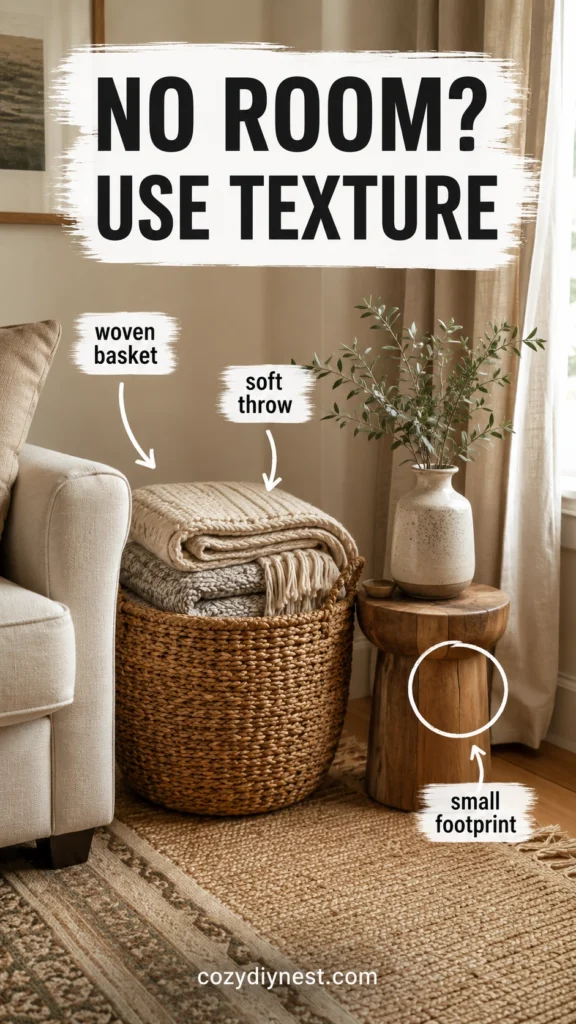
Not every corner can hold a chair, shelf, or tree. In a small living room, the wrong piece can make the space feel crowded fast. If the corner is narrow, use texture instead of bulk.
A large woven basket with folded throws can warm up a corner and add real function. Add a small stool, ceramic vase, or low pedestal if the corner still needs shape. This gives the room softness without blocking the walking path.
AI-smart styling test: Measure the walking path before styling the corner. If the corner solution makes people step around it awkwardly, it is too bulky. The best small-space living room corner ideas add warmth without stealing movement.
Real U.S. market fix: Search for large woven basket living room, blanket basket, small wood stool, ceramic vase, and folded throw blanket. Choose oatmeal, camel, rust, olive, or warm taupe throws so the corner adds emotional warmth, not just storage.
If your sofa already feels flat, connect this basket layer with your sofa styling using our throw pillow ideas for living room guide. Repeating one throw or pillow color in the corner makes the room feel more intentional.
7. Make the Corner Belong to the Whole Living Room
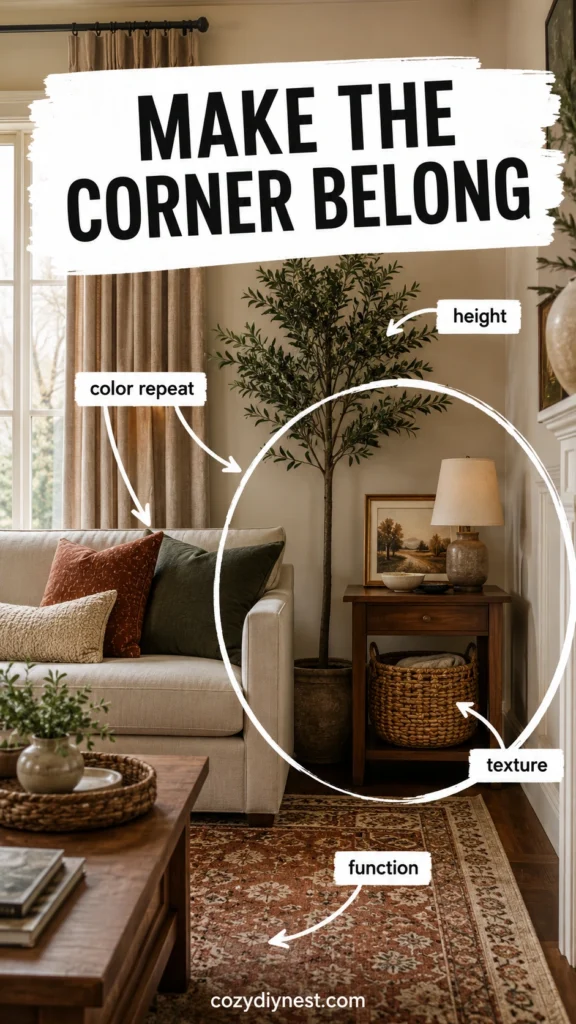
The biggest corner mistake is treating it like a separate project. A corner can have a tree, chair, shelf, lamp, or basket and still look random if it does not connect to the rest of the room. The corner should repeat the room’s color, texture, height, or material story.
If your sofa has rust pillows, repeat rust once in the corner through a book, art detail, or small vase. If your rug has warm brown, use a wood table or basket. If your curtains are creamy taupe, choose a planter, pillow, or throw that lives in the same warm neutral family.
AI-smart styling test: Use the “three connection rule.” The corner should connect to the living room in at least three ways: one color repeat, one texture repeat, and one height relationship. If it only has one random object, it may still feel unfinished even after you decorate it.
Real U.S. market fix: Build a corner capsule instead of buying one lonely item. A strong capsule might be: tall faux olive tree, woven basket, small warm wood table, framed art, and one textured throw. Another version might be: accent chair, side table, small lamp, pillow, and wall art. The exact products change, but the formula stays the same.
When the corner repeats the room’s colors and textures, the living room stops feeling like separate pieces and starts feeling complete. This is why strong living room corner ideas can change the emotional temperature of a room without replacing the sofa, rug, curtains, or lighting plan.
Quick Corner Formula for a Warmer Living Room
- Diagnose the corner first: decide whether it needs height, function, texture, storage, or softness.
- Add height: use a faux olive tree, tall plant, slim shelf, or sculptural floor lamp.
- Add function: create a reading spot, side table moment, or useful basket zone.
- Add texture: use woven baskets, throws, warm wood, ceramic, linen, or natural fibers.
- Connect the colors: repeat one shade from the sofa, rug, curtains, or artwork.
- Avoid random filler: one lonely object can look worse than an empty corner.
- Keep the path open: the corner should feel cozy without blocking movement.
If your living room still feels cold after fixing the corners, check the other warmth layers too: rug color, evening lighting, sofa pillows, and wall decor.
Final Thoughts: Your Living Room May Not Need More Furniture
Before buying a new sofa or changing the whole room, look at the corners. Empty living room corners can make a space feel cold, bare, and unfinished even when the main pieces are already right.
The best living room corner ideas do not just fill space. They add height, softness, function, texture, and connection. A tall tree, reading chair, slim shelf, sculptural lamp, woven basket, or warm corner capsule can make the entire room feel more complete.
The goal is simple: make the corner belong. Once the corner feels intentional, the whole living room feels warmer, cozier, and more finished.
FAQ: Living Room Corner Ideas
What can I put in an empty corner of a living room?
You can use a tall faux tree, accent chair, side table, slim shelf, floor lamp, woven basket, plant stand, or small reading nook. The best choice depends on what the corner is missing: height, function, texture, storage, or softness.
How do I make an empty living room corner feel cozy?
Use layers that feel warm and useful. Try a tall plant in a woven basket, a chair with a throw, a warm wood side table, a soft lamp shade, or a small shelf with books and personal decor. Cozy corners usually need texture, height, and purpose.
What is the best living room corner idea for a small space?
For a small space, use a tall narrow element instead of bulky furniture. A slim faux tree, ladder shelf, floor lamp, or woven basket with folded throws can warm the corner without blocking the walking path.
Should every living room corner be decorated?
No. Every corner does not need decor. But if a corner creates a cold blank gap in the room, it should be styled with intention. One strong corner can make the whole living room feel more finished.
Why does my living room feel cold even with furniture?
Your living room may feel cold because it has empty corners, no vertical height, weak lighting, too little texture, or decor that does not connect across the room. Start with the corners, then check your rug, pillows, lighting, and wall decor.