
You opened the curtains. You refreshed your decor. Maybe you even bought a new lamp — yet the room still feels dim. If your spring living room lighting isn’t giving that bright, airy feeling, the problem usually isn’t “not enough light.”
Most living rooms feel dark in spring because light is poorly distributed, too cool in tone, or trapped in shadow zones. Design editors at Architectural Digest often highlight that lighting shapes mood more than furniture does — especially when you’re trying to make a space feel lighter and calmer.
Below are 5 simple fixes that instantly improve spring living room lighting. Each section includes a visual example (image) and the exact shift that makes the room feel brighter — without changing your entire decor.
Fix #1: One Overhead Light Is Flattening Your Room
Look at the first image: the top half is lit by one ceiling fixture only. The light falls straight down, creating harsh shadows under furniture and leaving corners dim. Even if the bulb is bright, the room feels smaller because the walls aren’t glowing — they’re fading into shadow.
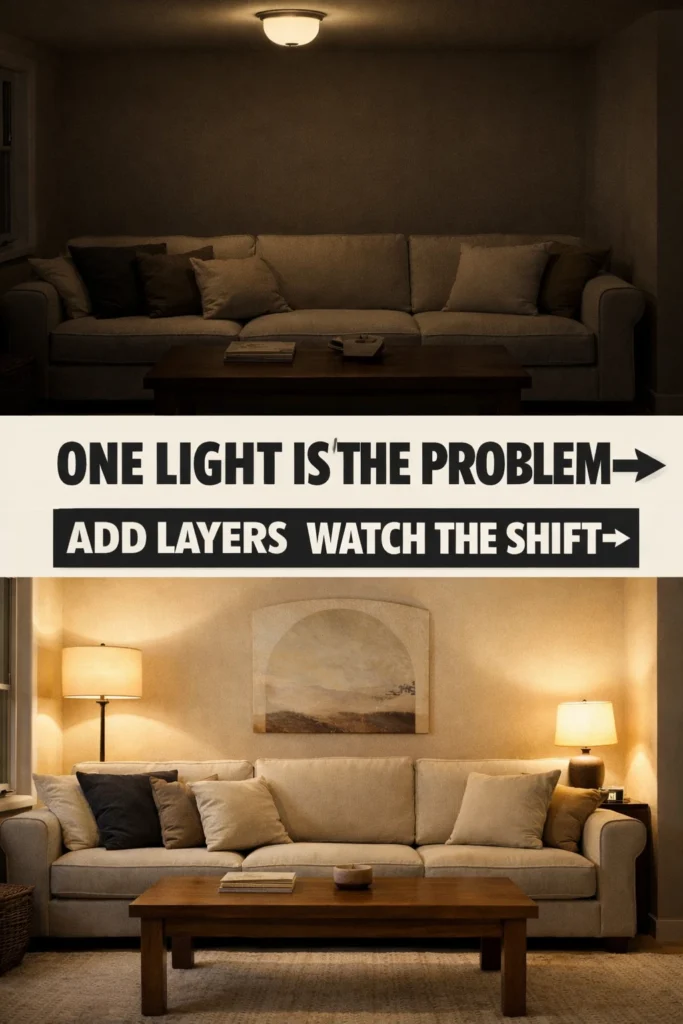
Now look at the bottom half: the same room feels instantly wider because light is coming from different heights. A floor lamp lifts the darkness from the corner, and a table lamp softens the sofa zone. This is what designers mean by layered lighting — and it’s the foundation of great spring living room lighting.
Do this: Keep the overhead light, but add two more light sources: one floor lamp and one table lamp. Aim for different heights so the light spreads horizontally across the room.
If your living room still feels heavy overall, pair this with our spring editing rules to remove visual weight first.
Fix #2: Your Bulb Temperature Is Working Against You
In the second image, the top half uses cool white light (often 4000K–5000K+). It makes neutral decor look flat and slightly bluish. Many people think the room is “dark” when it’s actually “cold” — and cold light makes shadows feel harsher.
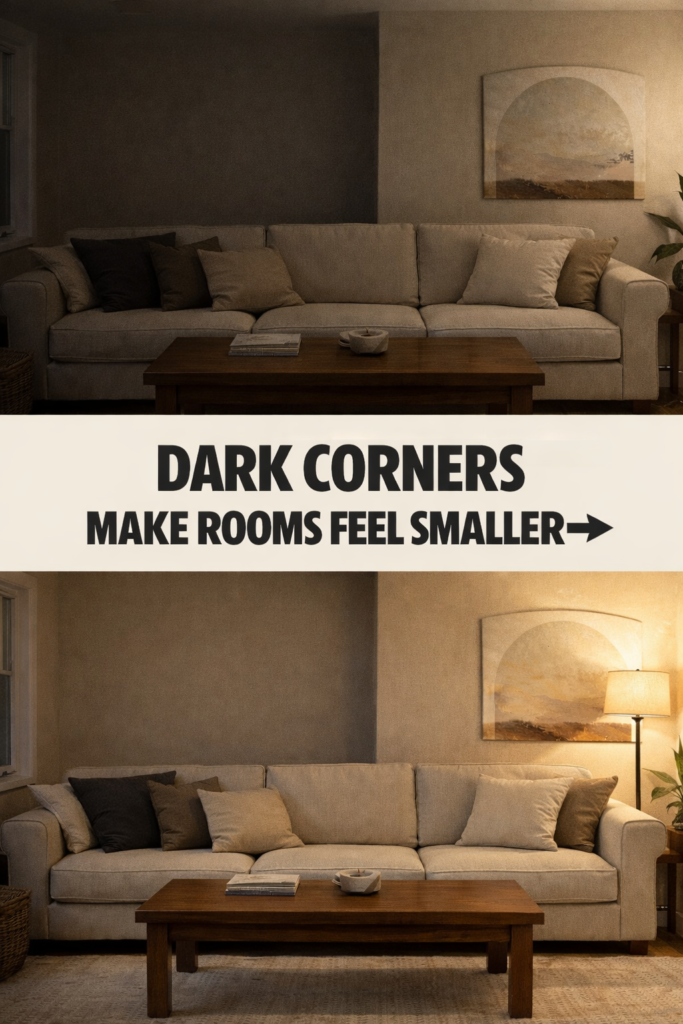
The bottom half uses warm white light (2700K–3000K). Walls look softer, textures look richer, and the room feels brighter even at the same brightness level. This is the fastest upgrade for spring living room lighting.
Do this: Switch bulbs to 2700K–3000K. If you want a clean look without yellow tones, choose 3000K.
For a cozy glow that still feels fresh in spring, browse our lighting mood ideas category.
Fix #3: Add Layered Lighting (Not Just More Lights)
The third image shows why adding “one brighter bulb” rarely fixes a dark-feeling room. With only one light source, the room looks one-dimensional. The shadows don’t disappear — they just shift.

When lighting is layered, the room gains depth: warm pools of light create soft transitions instead of harsh contrast. This is why layered light is often the “secret” behind spaces that feel calm and magazine-ready.
Do this: Use the 3-layer formula:
- Ambient (general light)
- Task (reading or focused light)
- Accent (small lamp or shelf glow)
If you’re building a full seasonal refresh, explore our Seasonal Home Refresh Ideas for matching spring styling formulas.
Fix #4: Remove Shadow Pockets
Shadow pockets are the hidden reason many rooms feel “dark.” In the fourth image, notice the area behind the sofa — even if the center of the room is bright, that dark zone makes the space feel smaller and heavier.
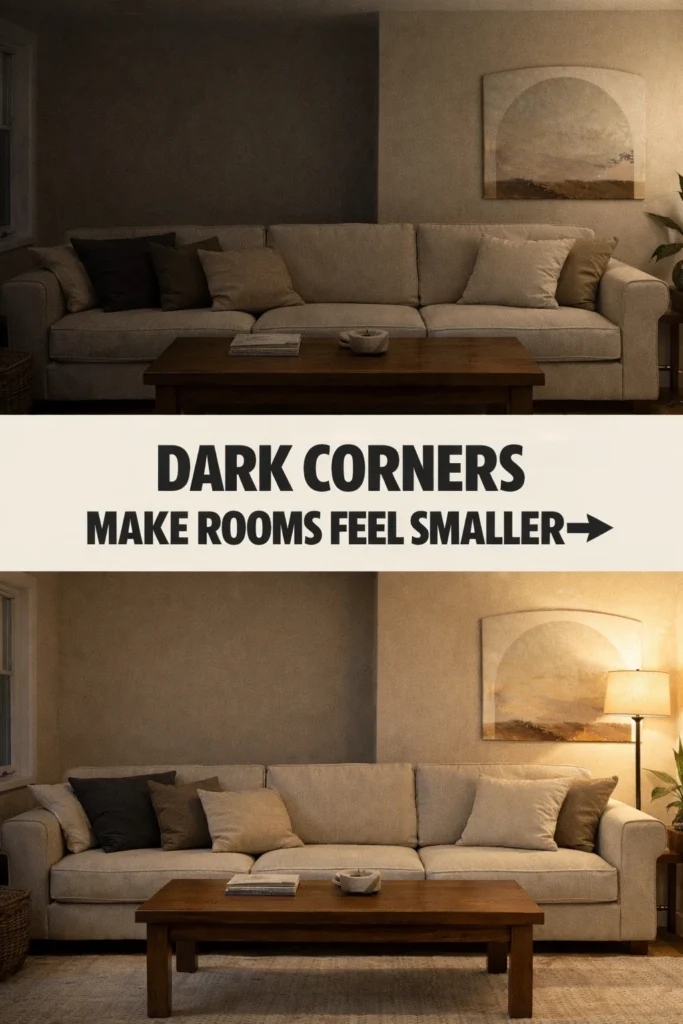
The fix is simple: place a slim lamp exactly where the darkness lives. A floor lamp behind a sofa, a small table lamp in a dim corner, or even a plug-in sconce can dissolve that shadow zone instantly.
Do this: Walk around the room at night with only one lamp on. Any corner that disappears is a shadow pocket. Add light there — not in the center.
Want your space to feel calmer overall? Combine this with our 15-minute spring home energy reset.
Fix #5: Add One Reflective Surface to Multiply Light
The last image proves a surprising truth: you don’t always need more lamps — you need more reflection. When light hits a mirror, glass, or soft metallic surface, it bounces and spreads. This is one of the fastest ways to upgrade spring living room lighting without adding clutter.

Do this: Place a mirror opposite a window, or place it near a lamp to amplify the glow. Even a medium mirror can make the room feel deeper and brighter.
If your walls feel visually messy, simplify them with our statement wall decor ideas so the reflection looks clean and intentional.
The 10-Minute Spring Lighting Reset Checklist
- Add one lamp at a different height (not just overhead)
- Switch to 2700K–3000K warm bulbs
- Use 3-layer lighting: ambient + task + accent
- Light one shadow pocket (behind sofa or dim corner)
- Add one mirror to multiply light
When your spring living room lighting is layered and warm, the entire room feels calmer — even before you change decor. Keep building your seasonal transformation with our seasonal home refresh ideas.
FAQ: Spring Living Room Lighting
Why does my living room feel dark even when the lights are on?
Because brightness and lighting distribution are different. If light comes from one source only, corners stay dim and shadows make the room feel smaller.
What bulb temperature is best for spring living room lighting?
Warm white bulbs (2700K–3000K) create a softer, brighter-feeling glow that enhances neutral decor and reduces harsh contrast.
How many lamps should a living room have?
Most living rooms feel best with at least three light sources at different heights: a ceiling light plus a floor lamp plus a table lamp.